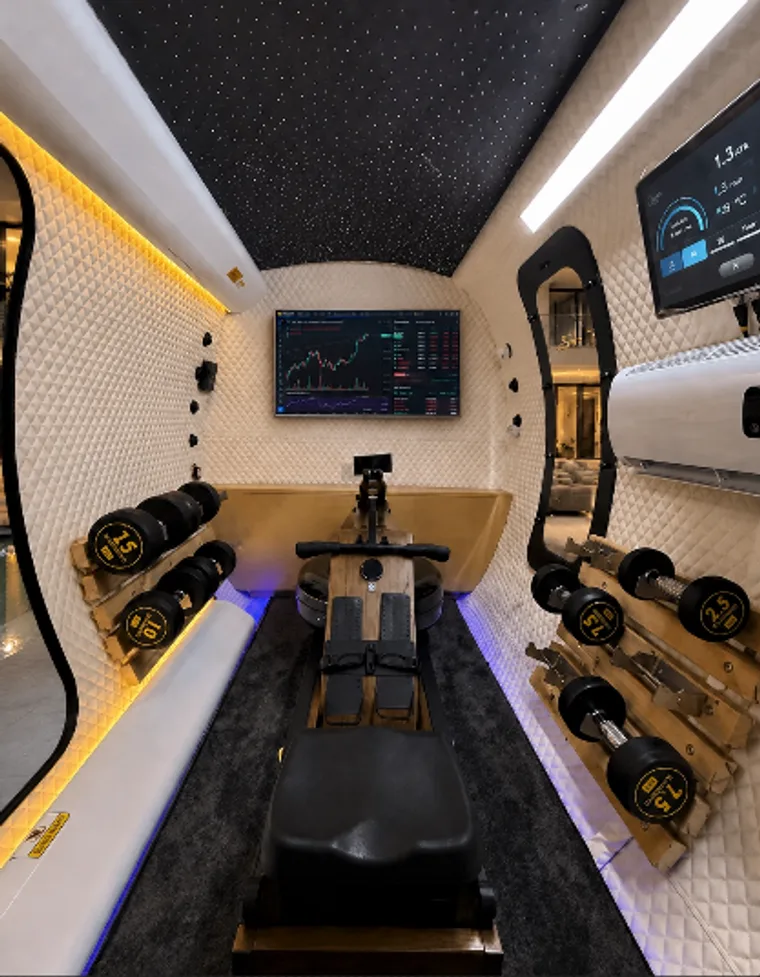
A hard-shell hyperbaric chamber is a rigid steel vessel that seals and holds pressure well above the air in the room. It is the format that reaches 2.0 ATA, and it is the only format that accepts Advanced Oxygen.
This page covers what the steel makes possible, what it asks of a room, and how the sit-up and lay-down formats differ. If you are still choosing between materials, the hard-shell versus soft-shell comparison sets them against each other, and the soft-shell page covers the other side in the same depth as this one.
What is a hard-shell chamber made of?
A sealed steel cabin. Altura One is built from 2.5 mm 304 stainless steel with a 10 mm polycarbonate door, and two large viewing windows let you see out through the session.
That construction is the whole reason the format exists. Fabric can be made to hold 1.5 ATA. Getting to 2.0 and holding it steady for an hour takes a rigid vessel, and everything else about a hard-shell follows from that decision: the weight, the footprint, the fact that it stays where you put it.
What pressure does a hard-shell chamber reach?
On Atlas One and Altura One, up to 2.0 ATA, with the bottom of the range differing by model.
- Atlas One runs 1.5 to 2.0 ATA.
- Altura One runs 1.3 to 2.0 ATA, so it starts gentler.
ATA is atmospheres absolute, where ordinary sea-level air is 1.0. At 2.0 ATA the cabin is at twice the pressure you are sitting in now.
The wider range on Altura One is worth noticing if more than one person will use the chamber and they want to start in different places. Atlas One’s floor is higher, so it begins where a soft-shell ends.
Which oxygen systems does a hard-shell take?
On Atlas One and Altura One, both of them, and this is the practical difference from a soft-shell.
Standard Oxygen is continuous flow through a mask, running the whole session. It ships as standard: 93 to 97% concentrator purity on Atlas One, 93% on Altura One.
Advanced Oxygen is BIBS, a built-in breathing system that is inhale-activated and routes your exhaled breath out of the cabin rather than into it. It is an upgrade on both, at 95 to 98% on Altura One. BIBS explained covers how the system works, and the continuous flow vs BIBS entity page puts the two side by side at equipment level. The oxygen systems hub is the way in if you have not met either.
Specify it at order. BIBS is not retrofittable. Of everything you choose on a hard-shell, this is the one that cannot be revisited later, which makes it worth more thought than its line on a quote suggests.
What does a hard-shell chamber need from a room?
More than a soft-shell, and honestly it needs a room rather than a corner.
| Atlas One | Altura One | |
|---|---|---|
| Cabin | L 2,000 x W 887 x H 1,600 mm | 900 x 2,200 mm cabin |
| Footprint | 0.89 x 2.00 m | 0.90 x 2.20 m |
Atlas One measures 962 mm wide including its control panel, to a tolerance of about 10 mm, which is the number that matters for a doorway rather than the 887 mm cabin figure.
Those are the cabins alone. You need clearance around them to get in and out, and the machines that run the chamber sit nearby. Planning the room walks through the measurements properly. We confirm the exact layout for your room before you commit.
Getting it into the room
The footprint is the number people plan around, but the one that catches them out is the doorway. Atlas One’s 962 mm width including the control panel is what has to pass through, not the 887 mm cabin. Corridors, stair turns and lift dimensions matter for the same reason.
None of that is usually a problem. It is a problem when it is discovered on delivery day, which is why we measure the route in as well as the room before anything ships.
Who is a hard-shell chamber for?
Someone who has decided this is a daily thing and wants the ceiling that goes with that decision. If you are going to use a chamber most days for years, the difference between 1.5 and 2.0 ATA, and between Standard and Advanced Oxygen, is what you are actually paying for.
It can also suit a practice. A hard-shell stays put and takes a service schedule. Which one depends on how many people will use it in a day, and that is worth working through on a call before choosing.
Who it is not for: anyone who cannot commit floor space, anyone in a rental they expect to leave, and anyone who wants to move the chamber between rooms. Those are soft-shell requirements, and the soft-shell page is the honest read on that format.
Sit-up or lay-down: which format?
Both are monoplace, meaning one person. The difference is posture.
Atlas One is sit-up. You are upright in a seat, which suits reading or working through a session, and it takes the smaller floor of the two.
Altura One is lay-down. Longer and slightly wider as a result. It suits anyone who would rather sleep through the hour, and anyone for whom getting into a seated cabin is the awkward part.
Neither is the better chamber. They are two answers to how you want to spend the hour, and the full chamber range has the larger formats if one person is not the constraint.
How does a session run?
You get in, close the door, and the chamber takes itself up to the pressure you set over a ramp rather than in one step. It holds there for the session and comes back down the same way. The ramp is not a formality: it is the part that makes a sealed vessel comfortable to sit in, and it is why a session is longer than the time at pressure.
Oxygen runs through the session. On Standard Oxygen that is a mask with continuous flow, so it is delivering whether you are breathing in or out. On Advanced Oxygen the built-in system is inhale-activated instead, and your exhaled breath is routed out of the cabin rather than into it, which is what keeps the cabin itself at ordinary air rather than enriched.
There is nothing to operate once you are in, and most people read, work or sleep.
What does a hard-shell chamber cost?
Hardware from AUD 78,900 — delivered & installed, for Atlas One. Altura One from AUD 99,900. Both carry a 2 year parts and labour warranty.
The other HQ hard-shells start higher. Solaris Mono is from AUD 111,900, Aurora from AUD 149,900 and Solaris Duo from AUD 159,900. The Magna walk-in is priced on quote, specified with you on a call.
Delivered and installed means the chamber arrives, is placed and commissioned in the room you chose, and you are run through operating it before we leave. A direct service line covers anything afterwards. Complex installs, such as crane access or a difficult site, are quoted separately.
For context, the soft-shell way in starts at AUD 24,900, so the step up to sealed steel is the single largest decision in the range. What the gap buys is the pressure ceiling, the Advanced Oxygen path, and a vessel built to stay in one place rather than pack down.
If that trade is the thing you are weighing, the comparison guide is the place to start.